
If you have started looking at childcare in Perth, you have probably asked yourself what is Montessori, and how it differs from the centre down the road. In short, Montessori is an approach to early learning where children choose from carefully prepared activities, work at their own pace and learn by doing, with educators guiding rather than directing.
The approach is named after Maria Montessori, an Italian doctor and educator who opened her first classroom in Rome in the early 1900s. She watched how young children actually learn and built a way of teaching around it. More than a century later, the same ideas sit at the centre of Montessori classrooms around the world, including ours in Fremantle and Maddington.
Children learn by doing
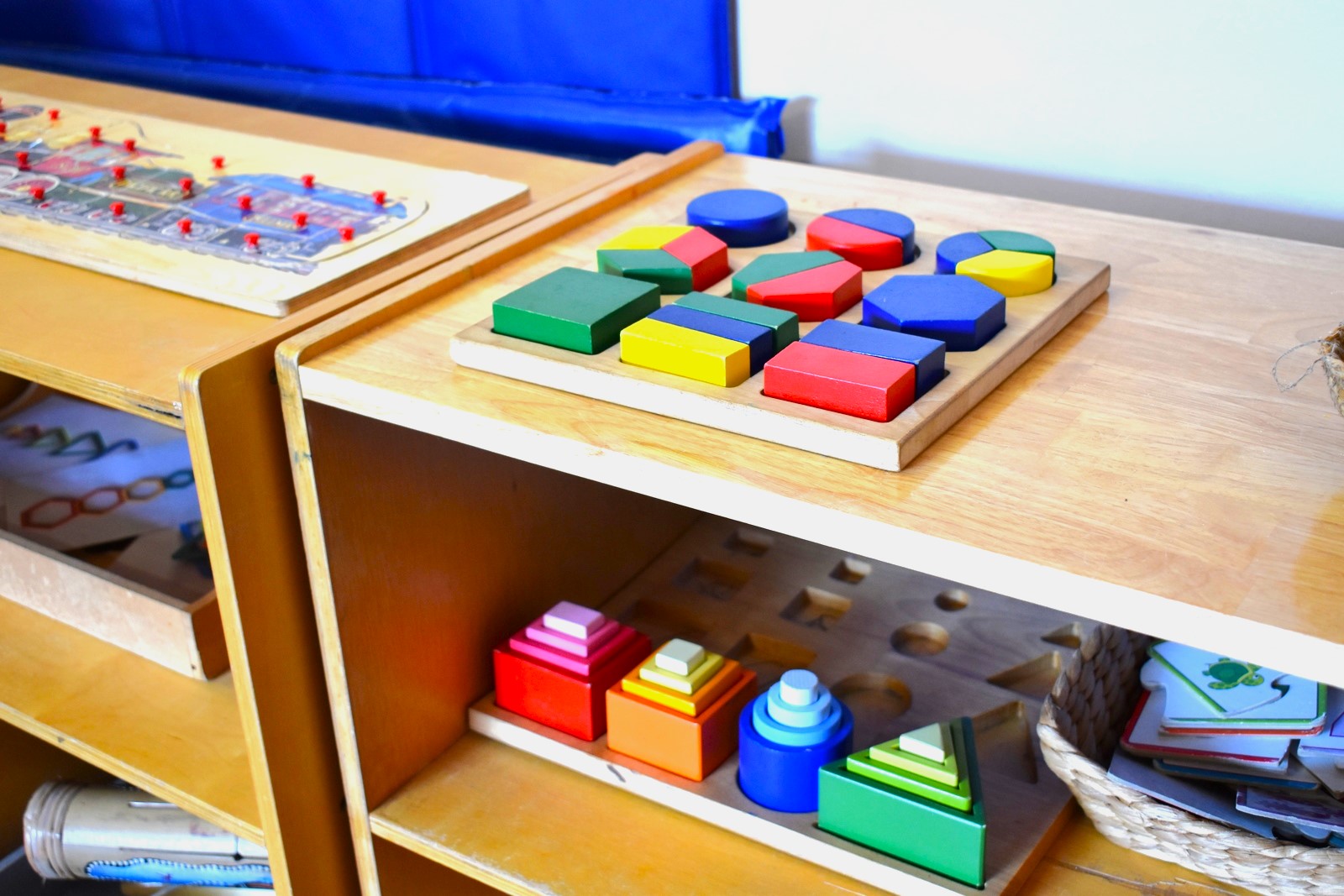
A Montessori room is full of hands on materials. Wooden cylinders that fit into matching holes, beads that can be counted and grouped, jugs for pouring, cloths for wiping. Each one is designed to teach one idea clearly, and many let a child see and correct their own mistakes without an adult stepping in.
Maria Montessori believed that play is the work of the child. A toddler carefully pouring water from one jug to another is building concentration, coordination and independence all at once, even though to them it simply feels like something interesting to do.
The prepared environment
You will hear Montessori educators talk about the prepared environment. It means the room itself is set up to support learning. Shelves are low so children can reach everything. Materials are kept in the same place so children know where to find them and where to return them. Furniture is child sized, and there is room to work on a table or on a small mat on the floor.
Because everything is within reach, children do not have to wait for an adult to hand them an activity. They choose, work, pack away and choose again. Over time this builds a strong sense of order and a real belief that they can do things for themselves.
Freedom within limits
Montessori children have a lot of choice, but it is not a free for all. Children can choose their activity, where they work and how long they spend on it, as long as they use materials respectfully and do not disturb the wellbeing of others. This balance helps children learn self control and consideration for the people around them.
At Orchard Montessori, children can work on their own or in small groups, and materials are presented individually or to a few children at the same stage of development.
Mixed ages and the role of the educator
Montessori rooms often group children across a range of ages rather than by single birthdays. Our centres group children from 0 to 2, 2 to 3 and 3 to 5 years. Younger children learn by watching older ones, and older children consolidate what they know by helping.
The educator’s role is to observe closely, notice what each child is ready for, and introduce the next material at the right moment. It is a quieter style than many parents expect, and it takes real skill. You can read more about how we approach this on our About page.
What Montessori is not
A few common myths are worth clearing up. Montessori is not only for gifted children, and it is not a rigid program where children are left alone all day. It is also not about pushing academic work early. The focus in the early years is on independence, concentration, coordination and a love of learning, which give children a strong base for everything that follows.
Is Montessori right for your child?
Most children thrive in a calm, well organised room where they are trusted to make choices. Some settle into it quickly, others take a few weeks. The best way to know is to visit, watch a class at work and ask questions about how the day runs.
When you visit any centre, look at how the children move around the room, how the educators speak to them, and whether materials are within reach and cared for. Those small details tell you a lot about the kind of learning that happens there.
How Montessori supports the early years
The years from birth to five are a time of rapid growth. Montessori pays close attention to what children are drawn to at each stage. A baby is fascinated by movement and faces, a toddler wants to do everything themselves, and a four year old is hungry for names, numbers and how things work. Materials and routines are chosen to match these interests, so learning feels natural rather than forced.
This is also why Montessori rooms put so much weight on routine and order. Young children feel secure when they know what comes next and where things belong. That security frees them to explore, try new things and recover quickly from small setbacks.
To see how this works day to day, book a tour at our Fremantle centre on 08 9336 4965 or our Maddington centre on 08 9493 5071, or send us a message through our contact page.
